



The Pipeline That Made Perfect Sense (Until It Didn't)
Your CI/CD pipeline worked great when you had one repository, one build, one deployment. You pushed code, tests ran, and the artifact landed in production. Simple, predictable, fast.
Then you broke the monolith into microservices. And suddenly the pipeline that served you well for years started causing more problems than it solved.
Builds take 40 minutes. A change to one service triggers tests across a dozen others. Deployment order matters but nobody documented it. A single failing test in an unrelated service blocks a critical fix from reaching production. Engineers wait. Customers wait.
This is not a tooling problem. It is an architectural mismatch. The pipeline was designed for a world with one deployable unit. Microservices create a world with dozens, sometimes hundreds. The assumptions built into traditional CI/CD pipelines break down almost immediately when applied to distributed service architectures.
This post explains exactly why that happens and what high-performing engineering teams do about it.
What CI/CD Pipelines Were Actually Designed For
To understand the mismatch, it helps to understand the original design assumptions behind most CI/CD pipelines.
Traditional CI/CD was built around the monolith mental model:
- One repository (or one primary build artifact)
- One test suite that validates the entire system
- One deployment unit that replaces the previous version
- Sequential stages: build, test, deploy
- A single team or a small number of teams owning the full pipeline
Tools like Jenkins, early GitLab CI, and CircleCI were designed with these assumptions baked in. The pipeline is a linear sequence. Everything runs in order. The build either passes or fails. You deploy the whole thing.
This model works well. For monoliths.
Why Microservices Break the Traditional Pipeline Model
Microservices introduce a set of constraints that are fundamentally incompatible with the linear, single-artifact pipeline model.
Independent deployability
Each microservice should be independently deployable. That is the core promise of the architecture. A change to the payments service should not require coordinating a deployment with the user service, the notification service, and the API gateway.
But traditional pipelines are built around a single deployment event. When you try to apply that model to 50 services, you end up with one of two bad outcomes: you coordinate all deployments together (defeating the purpose of microservices) or you create 50 separate pipelines with no consistency, no shared standards, and a maintenance burden that grows with every new service.
Cross-service testing complexity
Integration testing in a monolith is straightforward. Everything is in one place. You can spin up the entire application in a test environment and run end-to-end tests against it.
In a microservices architecture, a meaningful integration test requires multiple services to be running simultaneously, at compatible versions, with correct configuration. Orchestrating that in a CI pipeline is genuinely hard. Most teams either skip the integration tests (increasing production risk) or run a full environment for every pipeline run (making builds slow and expensive).
Dependency and deployment order
Services depend on each other. If service A calls service B, and you deploy a breaking change to service B before service A is updated to handle it, you have an outage.
Traditional pipelines have no concept of service dependencies. They do not know that the payment service must be deployed before the checkout service when the API contract changes. That knowledge lives in someone's head, or in a Confluence page nobody reads.
Cascading test failures
In a monolith, a failing test is unambiguous. Something in the system is broken. In a microservices setup, a failing test in pipeline X might mean pipeline X has a bug, or it might mean service Y (which pipeline X depends on) deployed a breaking change, or it might mean the shared test environment is flaky, or it might mean a network timeout in the test infrastructure.
Debugging cascading failures across pipelines is one of the highest-friction activities in microservices development. DORA research consistently identifies it as a major contributor to poor Lead Time for Changes and low Deployment Frequency scores.
Configuration and secret sprawl
A monolith has one configuration surface. Microservices have dozens. Each service needs its own environment variables, secrets, feature flags, and infrastructure configuration. Managing that consistently across 50 pipeline definitions is a significant operational burden, and inconsistency is where security vulnerabilities hide.
The Four Patterns High-Performing Teams Use
Teams that have solved this problem well tend to converge on a set of architectural patterns for their CI/CD infrastructure. These are not silver bullets. They are trade-offs, and the right combination depends on your team size, service count, and deployment frequency.
1. Trunk-based development with feature flags
The first thing most high-performing microservices teams do is move to trunk-based development. Instead of long-lived feature branches that create merge conflicts and integration pain, engineers commit small changes directly to the main branch behind feature flags.
This matters for CI/CD because it dramatically reduces the complexity of the integration problem. If every service is always building from a known-good main branch, the state space of "what is deployed where" becomes much more manageable.
Google's DevOps research consistently finds trunk-based development to be one of the strongest predictors of high deployment frequency and low change failure rate.
2. Service-scoped pipelines with a shared template layer
The solution to the "50 separate pipelines with no consistency" problem is not to merge them back together. It is to separate the pipeline definition from the pipeline implementation.
High-performing platform teams build a shared pipeline template that encodes the organization's standards for building, testing, and deploying a service. Individual service pipelines inherit from this template and override only what they need to.
In practice this looks like:
- A reusable CI/CD template maintained by the platform team (in GitHub Actions, GitLab CI, or Tekton)
- Individual services reference the template and pass service-specific parameters
- Updates to the template propagate automatically to all services
- Services can opt into experimental pipeline features without affecting others
This is the CI/CD equivalent of the golden path. It gives teams autonomy while enforcing consistency at the infrastructure level.
3. Contract testing instead of shared integration environments
Shared integration environments are the most common solution to the cross-service testing problem. They are also one of the most expensive and fragile. A flaky shared environment blocks every team that depends on it. Keeping it up to date with the latest version of every service is a full-time job.
Contract testing is a better approach for most service-to-service interactions. Tools like Pact allow each service to define a contract describing what it expects from the services it calls. Those contracts are verified independently, without requiring all services to be running simultaneously.
The result: fast, isolated, reliable tests that verify API compatibility without a shared environment. Integration environments still have a role for end-to-end smoke tests before production, but they stop being the primary mechanism for verifying service compatibility.
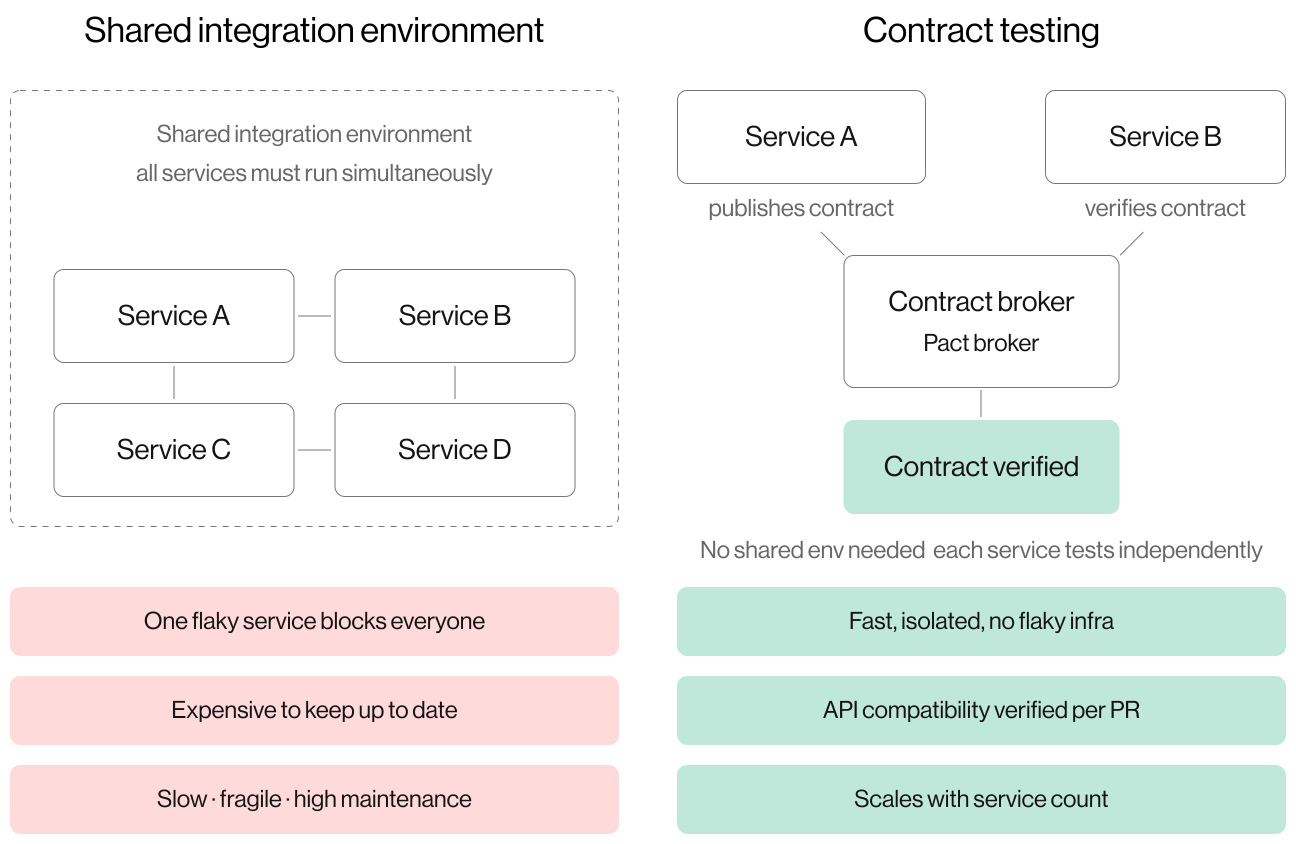
Figure 1: Contract testing (right) lets each service verify its API contract independently via a broker, eliminating the shared integration environment (left) that blocks all teams when a single service is flaky or out of date.
4. Progressive delivery and deployment decoupling
Deployment and release are not the same thing. Deploying code to production means getting the artifact onto the servers. Releasing means making the feature available to users. Decoupling these two events is one of the most powerful things you can do for microservices CI/CD.
Progressive delivery tools like Argo Rollouts, Flagger, and LaunchDarkly let you deploy a new version of a service to production, route a small percentage of traffic to it, monitor its error rate and latency, and automatically roll back if something goes wrong, all without human intervention.
This approach changes the risk profile of deployment entirely. Instead of "deploy and pray," you get "deploy gradually, observe continuously, roll back automatically." Deployment frequency goes up because the blast radius of each deployment goes down.
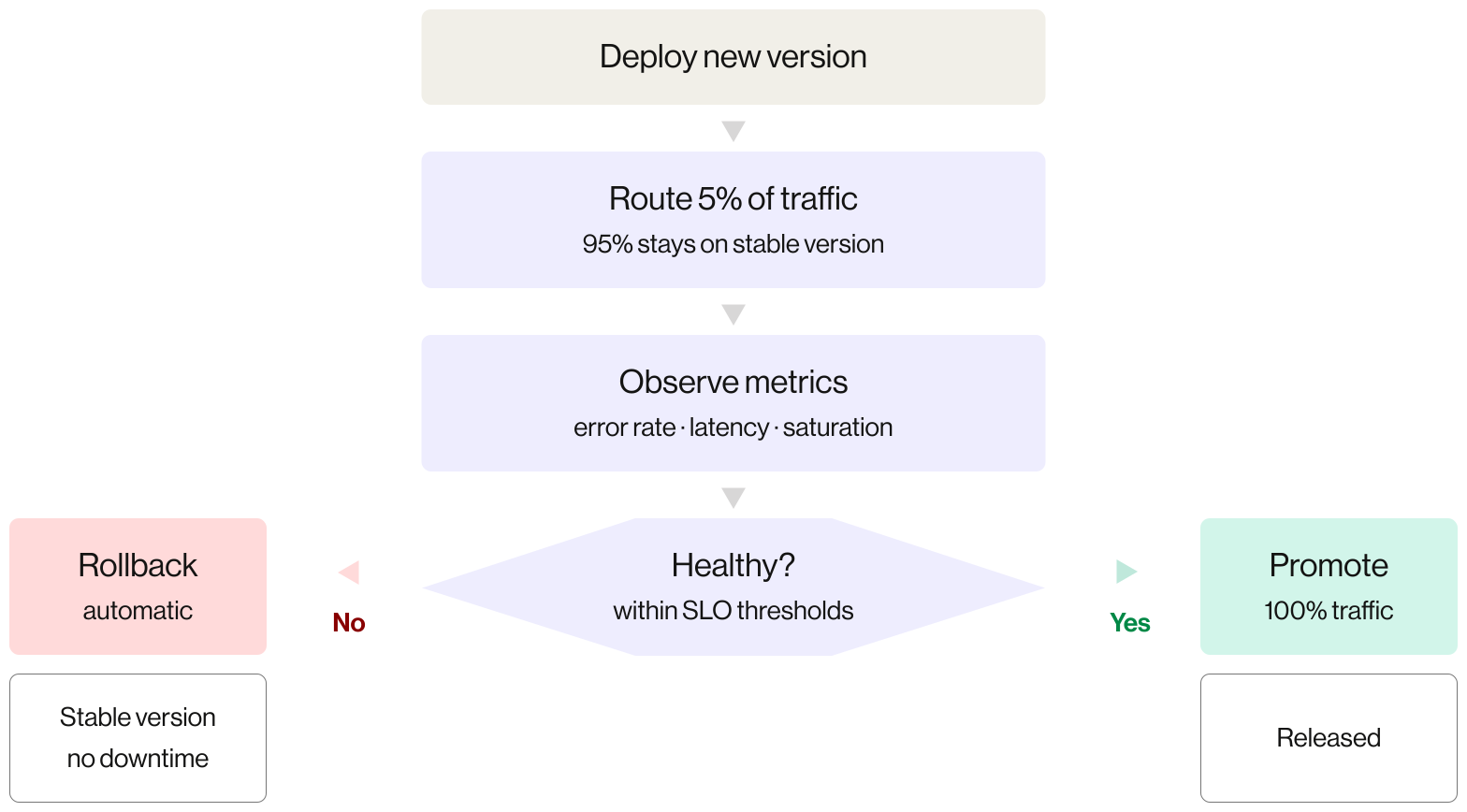
Figure 2: Progressive delivery routes traffic incrementally (5% to 25% to 100%), with an automated health check at each stage. Rollback is an exception path triggered automatically when metrics breach SLO thresholds, not a manual step.
The Organizational Problem Nobody Talks About
Most articles about CI/CD for microservices focus on tools. But the harder problem is organizational.
Traditional CI/CD pipelines are owned by a central DevOps or platform team. Microservices, done correctly, push ownership down to individual service teams. The pipeline ownership model has to change with it.
The tension looks like this: if every service team owns and maintains its own pipeline, you get 50 pipelines with 50 different approaches, 50 different security configurations, and 50 different on-call burdens when something breaks. If the central team owns all pipelines, service teams lose the autonomy that makes microservices valuable.
The answer is the same one platform engineering provides for infrastructure generally: a shared template layer maintained by a platform team, with service-level configuration owned by individual teams. The platform team owns the standard. The service team owns the deviation.
This model only works if the platform team treats the pipeline template as a product. That means versioning it, documenting breaking changes, providing migration guides, and gathering feedback from service teams on what is and is not working.
What to Actually Fix First
If your pipeline is already struggling with microservices, the temptation is to rewrite everything. Resist it.
The highest-leverage interventions, roughly in order of impact and implementation cost:
Isolate your test stages. If a single test failure in any service blocks all deployments, fix that first. Service pipelines should fail independently. A broken test in the payments service should not stop the user service from deploying.
Introduce contract testing for your highest-traffic service interactions. Pick the two or three service pairs that cause the most integration failures and add contract tests. Do not try to add contract testing everywhere at once.
Build one reusable pipeline template. Start with your most commonly deployed service type. Build a template that works for that type, get one or two teams using it, and iterate. Expand from there.
Add deployment observability before you add deployment automation. You cannot safely automate progressive delivery if you do not have reliable metrics for what "healthy" looks like. Get your error rate, latency, and saturation dashboards solid before you wire up automated rollback.
Standardize your secrets management. Configuration and secret sprawl is a security risk and a reliability risk. Pick one approach (HashiCorp Vault, AWS Secrets Manager, Kubernetes secrets with External Secrets Operator) and migrate your highest-risk services to it.
Tools Worth Knowing
These are the tools that appear most frequently in well-architected microservices CI/CD setups:
Pipeline orchestration: GitHub Actions, GitLab CI, Tekton, Argo Workflows
Contract testing: Pact, Spring Cloud Contract
Progressive delivery: Argo Rollouts, Flagger, Spinnaker
Feature flags: LaunchDarkly, Unleash, Flagsmith
Secrets management: HashiCorp Vault, External Secrets Operator
Artifact and image management: JFrog Artifactory, Harbor
No single tool solves the microservices CI/CD problem. The architecture matters more than the tools.
How to Know If Your Pipeline Is the Bottleneck
Ask these questions about your current setup:
- Does a failing test in service A block deployment of service B?
- Do your builds take longer than 15 minutes for the majority of services?
- Is deployment coordination done manually via Slack messages or Confluence docs?
- Do you run a single shared integration environment that all teams depend on?
- Has a pipeline configuration change ever caused an outage?
- Do new services take more than a day to get a working pipeline?
If you answered yes to two or more of these, your CI/CD architecture is actively limiting your deployment frequency and your engineering velocity.
The Bottom Line
CI/CD pipelines are not neutral infrastructure. They encode assumptions about how software is built and deployed. Traditional pipelines encode the assumptions of the monolith: one artifact, one test suite, one deployment.
Microservices require different assumptions: independent deployability, isolated failure domains, contract-based compatibility, and progressive delivery. Applying a monolith pipeline model to a microservices architecture does not just slow teams down. It undermines the core architectural benefits that microservices were supposed to deliver.
The fix is not to pick a better tool. It is to align your CI/CD architecture with your service architecture. That means service-scoped pipelines built on shared templates, contract testing instead of shared environments, and progressive delivery instead of big-bang deployments.
The teams that get this right ship faster, break less, and spend less time managing pipeline failures. That is the engineering velocity that microservices promised in the first place.
Further reading: