



The Problem With DevOps That Nobody Talks About
DevOps worked. And then it broke.
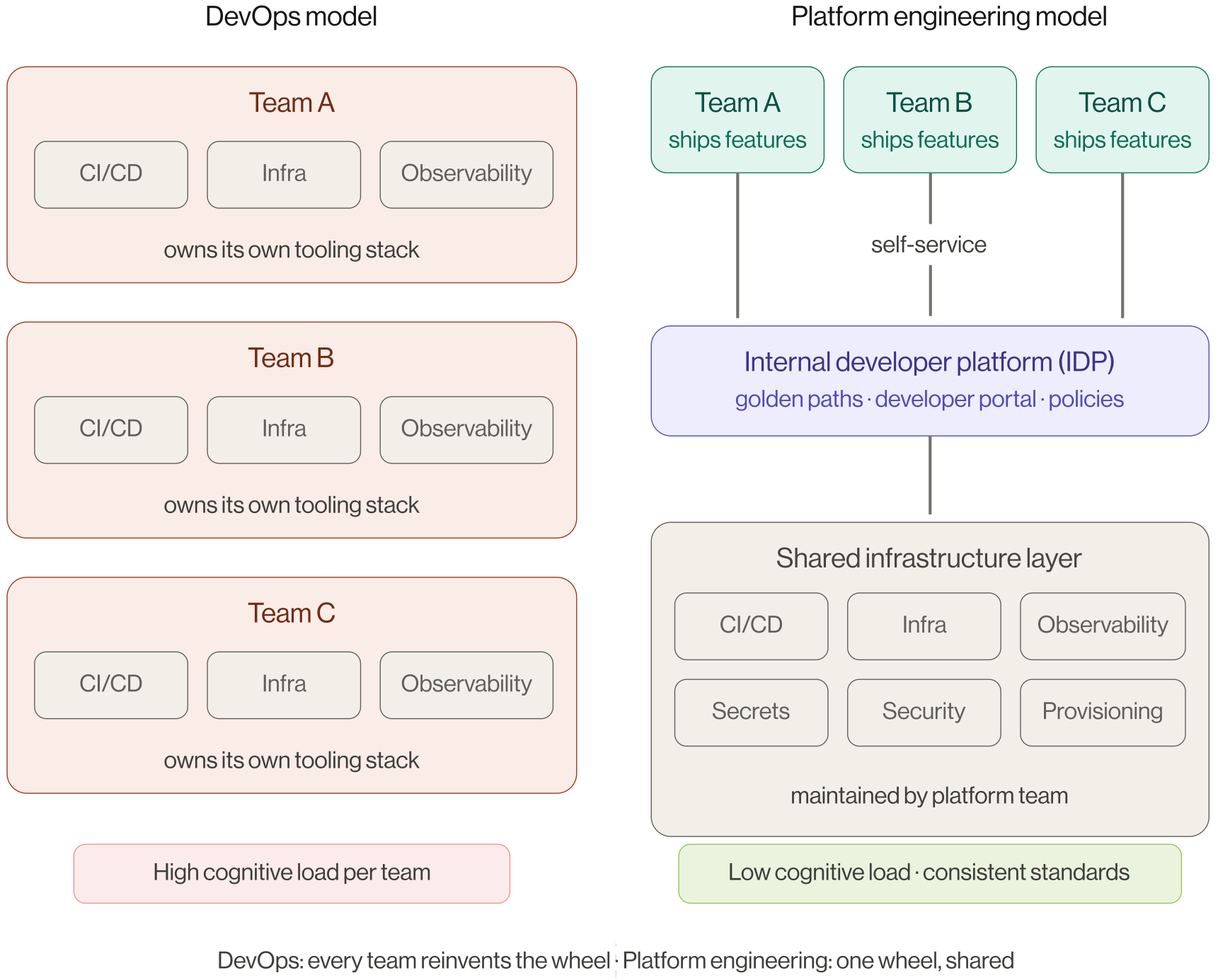
Not because the principles were wrong (autonomy, fast feedback loops, end-to-end ownership) but because of what happened when you scaled them. Every team built their own pipelines. Every squad chose their own deployment tooling. Every service had its own approach to observability, secrets management, and infrastructure provisioning.
The result? Thousands of engineers spending 20–40% of their time not building product features, but wrestling with infrastructure complexity that had nothing to do with the problems they were hired to solve.
Platform engineering is the industry's answer to that problem. And in 2026, it's no longer an emerging trend. It's rapidly becoming the standard operating model for engineering organizations that want to scale without chaos.
What Is Platform Engineering?
Platform engineering is the discipline of designing and building internal developer platforms (IDPs) that abstract away infrastructure complexity and give product engineers self-service access to the tools, environments, and workflows they need to ship software.
Where DevOps asked every team to own their operational concerns, platform engineering centralizes that work into a dedicated platform team, one that treats internal developers as its customers and the developer experience (DevEx) as its product.
The CNCF (Cloud Native Computing Foundation) defines it this way:
"A platform for cloud-native computing is an integrated collection of capabilities defined and presented according to the needs of the platform's users."
In plain terms: instead of every team figuring out how to deploy to Kubernetes, manage secrets, configure CI/CD, and set up monitoring, a platform team builds a single, well-paved path that makes all of that trivially easy.
DevOps vs Platform Engineering: What Actually Changed
This is where most explanations go wrong. Platform engineering is not a replacement for DevOps culture. It's an evolution of how DevOps principles are operationalized at scale.
| DevOps | Platform Engineering | |
|---|---|---|
| Core idea | Break silos between dev and ops | Build internal products for developers |
| Who owns infra? | Individual teams | Centralized platform team |
| Tooling | Each team chooses their own | Standardized, self-service platform |
| Cognitive load | High (each dev deals with infra) | Low (platform abstracts complexity) |
| Scale | Works well at small scale | Designed for large organizations |
| Developer role | "You build it, you run it" | "You build it, the platform helps you run it" |
The shift isn't about removing developer ownership. It's about removing accidental complexity, the kind that comes from every team reinventing the same infrastructure wheel, slightly differently, with slightly different failure modes.
The Core Concept: The Internal Developer Platform (IDP)
The Internal Developer Platform (IDP) is the tangible artifact that platform engineering produces. It's not a single tool. It's an integrated layer of capabilities that typically includes:
- Self-service infrastructure provisioning: developers can spin up environments, databases, and services without filing tickets or waiting for an ops team
- Golden paths: opinionated, pre-approved workflows for common tasks (deploying a service, adding observability, managing secrets) that encode best practices by default
- Developer portals: a unified interface (often built on Backstage) for discovering services, documentation, runbooks, and ownership information
- Automated compliance and security: policies enforced at the platform level, not bolted on by individual teams
- Observability out of the box: logging, metrics, and tracing configured automatically for services that run on the platform
The best IDPs follow a key design principle: the right path should be the easy path. If following security best practices requires more effort than skipping them, developers will skip them. The platform's job is to invert that equation.
Why Engineering Leaders Are Paying Attention Now
1. Developer cognitive load has become a performance bottleneck
Humanitec's 2023 Platform Engineering report found that developers in organizations without a platform team spend an average of 18 hours per week on tasks unrelated to feature development. That's nearly half a working week lost to configuration, environment issues, and infrastructure debugging.
At 100 engineers, that's the equivalent of 45 full-time engineers doing nothing but fighting tooling. The math makes the business case obvious.
2. The Kubernetes complexity wall
Kubernetes has become the default deployment substrate for most mid-to-large engineering organizations. But it was not designed for developers to use directly. It was designed for platform engineers to build on top of.
When product engineers are expected to write Kubernetes manifests, understand pod scheduling, manage RBAC, and debug cluster-level networking issues, you've created a system that requires specialist knowledge to operate at every layer. Platform engineering draws a clear line: Kubernetes is infrastructure that the platform team operates. Developers interact with a higher-level abstraction.
3. The "you build it, you run it" model doesn't scale uniformly
Full ownership works well when teams have the operational maturity and bandwidth to support it. But in practice, ownership becomes uneven. Some teams invest in runbooks, chaos testing, and SLOs. Others ship fast and defer operational concerns until something breaks at 2am.
Platform engineering creates a consistent floor of operational quality across the organization, without requiring every team to independently arrive at the same standards.
The Golden Path: Platform Engineering's Most Powerful Idea
The concept of a golden path (sometimes called a paved road) deserves its own explanation because it's central to how platform engineering delivers value, and it's often misunderstood.
A golden path is not a mandate. It's an invitation.
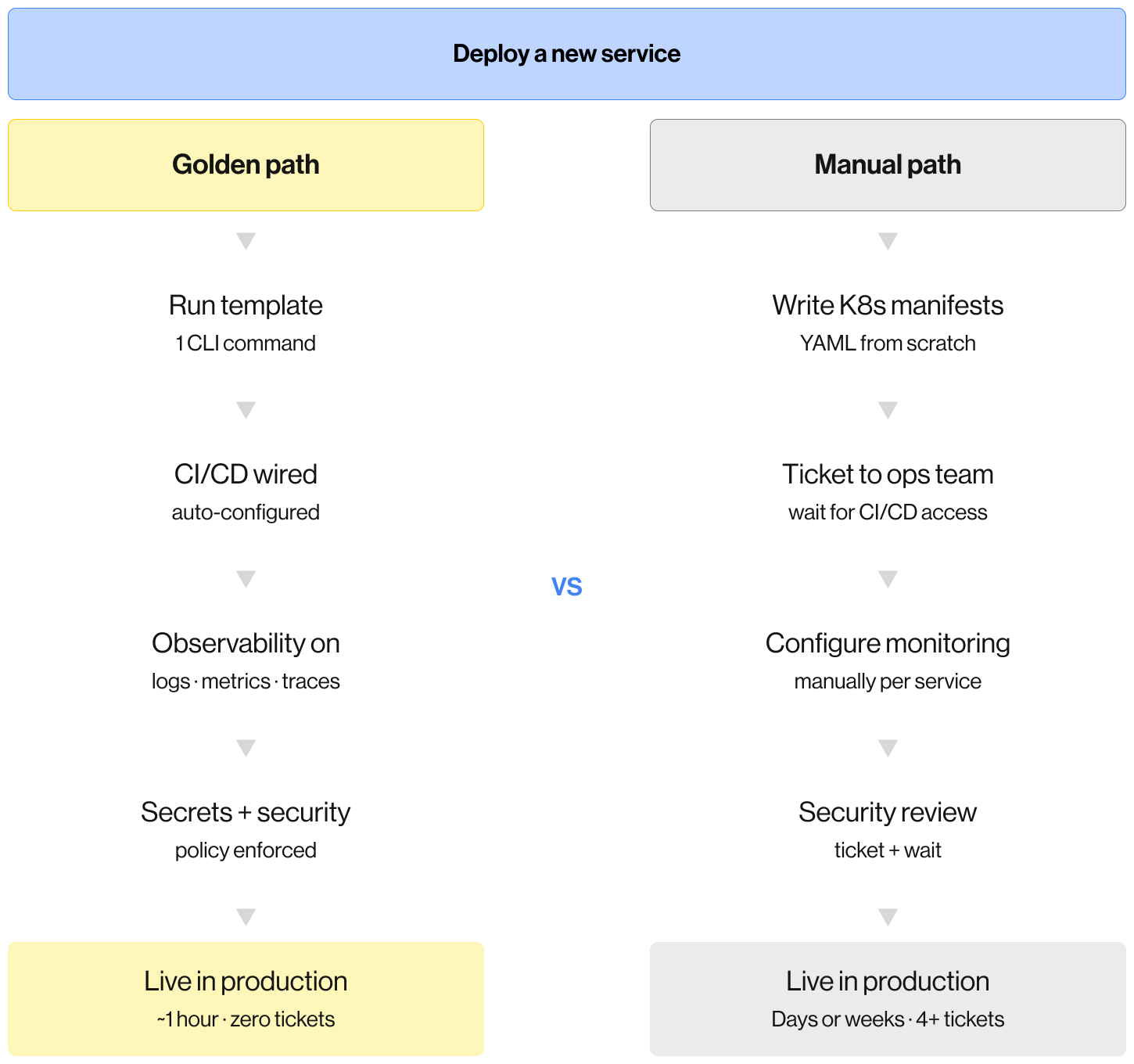
It's a pre-built, pre-approved, pre-configured workflow that covers the most common engineering tasks: creating a new service, deploying to production, adding a database, integrating with the auth system. When a developer starts a new service and follows the golden path, they get:
- A working CI/CD pipeline
- Observability configured and connected to the company's monitoring stack
- Secrets management wired up correctly
- Infrastructure provisioned in compliance with security policies
- Service registered in the internal catalog
In under an hour, without filing a single ticket.
Teams are still free to deviate from the golden path. But the golden path is so much easier that deviation only makes sense for genuinely unusual requirements. This is how platform engineering achieves standardization without mandates. It makes the right way the default way.
Spotify's engineering blog (where the concept was popularized) describes golden paths as a solution to the fragmentation that occurs when teams have "full autonomy but no coordination."
Platform Engineering in Practice: What the Team Actually Does
A platform engineering team is a product team. Its customers are internal developers. Its backlog is driven by developer experience research, support requests, and adoption metrics, not by external product requirements.
In practice, the team spends its time on:
Building and maintaining the IDP: the core platform product, including the developer portal, CI/CD templates, infrastructure modules, and self-service workflows.
Defining and evangelizing golden paths: working with teams to understand common workflows and building supported, opinionated paths for them.
Reducing toil: identifying recurring manual tasks that slow teams down and automating them into the platform.
Platform reliability: the IDP is mission-critical infrastructure. Platform teams own its SLOs, incident response, and capacity planning.
Developer experience measurement: tracking DORA metrics (Deployment Frequency, Lead Time, MTTR, Change Failure Rate) as proxies for platform health, alongside developer satisfaction surveys and platform adoption rates.
Common Misconceptions
"Platform engineering means re-centralizing ops" No. Product teams still own their services end-to-end. The platform provides capabilities. It doesn't own the services that run on top of it.
"We need a large team to do this" Platform engineering can start with 2–3 engineers focused on the highest-leverage pain points. Many organizations begin with a single golden path for their most common use case and expand from there.
"Backstage is platform engineering" Backstage is a developer portal framework, one component of an IDP. Platform engineering is the broader discipline of building and operating the full internal platform, of which a portal is just the interface layer.
"This is only for big companies" The investment threshold is lower than most assume. If your organization has more than 20–30 engineers and is spending meaningful time on infrastructure coordination, the ROI on a platform investment is typically positive within 6 months.
How to Know If Your Organization Needs Platform Engineering
Ask yourself these questions:
- Do developers regularly wait on other teams to provision infrastructure, get access, or unblock deployments?
- Is onboarding a new engineer to their first production deployment measured in days rather than hours?
- Do you have more than 3 different CI/CD setups across your teams?
- Are security and compliance concerns handled inconsistently across services?
- Is your DORA Lead Time for Changes measured in weeks?
If you answered yes to two or more of these, platform engineering is likely worth serious consideration.
Where to Start
You don't need to build a full IDP from day one. The practical starting point is:
- Audit current developer pain: survey your engineers on where they lose the most time. The answer is usually deployment, environment setup, or access/permissions.
- Pick one golden path: choose the most common workflow (e.g., deploying a new backend service) and build an opinionated, automated path for it.
- Measure adoption and feedback: treat it like a product. Does the golden path get used? Where does it break down?
- Expand incrementally: add capabilities based on developer feedback, not based on what looks impressive on an architecture diagram.
The Platform Engineering community and the CNCF Platforms Working Group are the best resources for going deeper, with real-world case studies from organizations that have already made the transition.
The Bottom Line
Platform engineering isn't a rebrand of DevOps. It's an acknowledgment that at a certain scale, giving every team full infrastructure ownership without a shared foundation creates more friction than it removes.
The engineering organizations that will scale effectively in the next five years are the ones that treat developer experience as a first-class product concern and invest in the internal platforms that make their best engineers faster, not just better-staffed.
The shift isn't away from developer ownership. It's toward giving developers better tools to exercise that ownership without drowning in accidental complexity.
Further reading: