


How AI-driven specification gathering is collapsing six-month timelines into six weeks, and why the best code starts with the right questions rather than the right prompts.
For two decades, software teams largely operated under one dominant assumption: agile was the only sensible way forward.
Waterfall was framed as rigid, slow, and too disconnected from reality. Agile offered something better: shorter cycles, faster feedback, and the freedom to adapt as requirements evolved.
That trade-off made sense when implementation was expensive.
Today, AI has changed the economics of software delivery. Code generation is becoming cheap. The hard part is no longer producing software. The hard part is knowing what should be produced in the first place.
This is where the Socratic method of software development becomes relevant. It combines the discipline of specification-led thinking with the speed of AI-assisted execution, then uses agile iteration where it matters most: after real users interact with the product.
The Specification Crisis
Most failed software projects do not fail because engineers are incapable of implementation.
They fail because the specification is weak:
- requirements are incomplete
- assumptions remain unchallenged
- contradictions go unnoticed
- edge cases emerge too late
For years, agile addressed this by accepting that the specification would be imperfect and discovering the truth incrementally through delivery.
That worked when code was expensive to write and expensive to change.
But AI coding agents invert that equation. If a full module can be regenerated quickly, the greatest cost is no longer implementation effort. It is ambiguity.
"Speed without direction is just a faster way to reach the wrong place."
The wave of vibe coding made this problem visible. Teams could generate impressive demos very quickly, but many of those systems were difficult to maintain, brittle under change, and poorly aligned to real business needs.
The issue was not that the models could not write code.
The issue was that nobody had forced the right questions early enough.
Enter the Socratic Phase
The Socratic method treats AI not as a code typist, but as an intelligent interviewer.
Instead of simply turning prompts into implementation, it interrogates the problem:
- what happens when the happy path breaks?
- what constraints matter in production?
- where does the requirement contradict the roadmap?
- what assumptions are being treated as facts?
In practice, this means structured dialogue between stakeholders and AI.
The product owner or architect describes the desired system. The AI probes for missing details, stress-tests assumptions, and surfaces scenarios that usually appear much later in delivery when fixing them is more expensive.
Examples of that questioning might include:
- what happens if a transaction is interrupted halfway through?
- how should approval flows behave when an approver is unavailable?
- what session behavior is expected across multiple active browser tabs?
This is not passive note-taking. It is adversarial specification refinement.
The output is not a transcript. It is a formal specification that becomes the source of truth for what gets built.
What a Strong Socratic Specification Produces
A strong specification should capture more than feature descriptions. It should make the system buildable.
That includes:
- functional requirements
- non-functional requirements
- edge cases
- data model expectations
- integrations
- error handling rules
- acceptance criteria
The goal is to turn stakeholder intent into something unambiguous enough for coordinated AI-assisted delivery.
Socratic specification in summary
AI conducts structured interviews with product owners, domain experts, and architects. It pushes on ambiguity, surfaces contradictions, and forces edge cases into the open. The result is a comprehensive specification that can act as a practical blueprint for implementation.
From Specification to Software
Once the specification is stable, the process becomes intentionally sequential.
This is where the method starts to look like waterfall again, but in a new context.
AI agents can now execute against a much clearer blueprint:
- implementation agents build defined parts of the system
- supervisor agents coordinate dependencies
- testing agents validate outcomes against acceptance criteria
- documentation agents produce technical and user-facing output in parallel
Because the specification is clearer, those execution stages compress dramatically.
The promise is not that planning disappears. It is that planning becomes more powerful because AI can interrogate and operationalize it at a speed that was not realistic before.
Why Timeline Compression Becomes Possible
Traditional projects often spread effort across:
- requirements
- design
- implementation
- testing
- deployment
The Socratic method changes the effort distribution.
Human expertise is concentrated earlier, during specification, where it has the highest leverage. Implementation, testing, and documentation then accelerate because the target is clearer.
The consequence is that projects with roughly the same scope can move far faster without relying on guesswork as a delivery strategy.
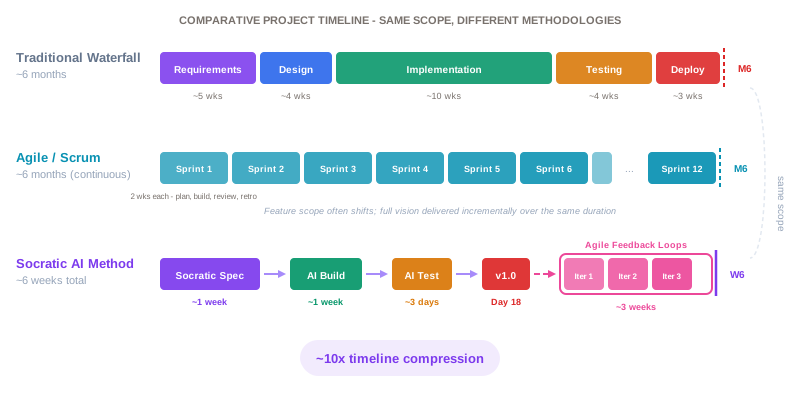
Figure: Comparative project timeline showing traditional waterfall, agile delivery, and the Socratic AI method for the same scope.
The Pivot Back to Agile
This is not a pure return to traditional waterfall.
The important shift comes after the first release.
Traditional waterfall often treats deployment as the end of the journey. The Socratic method treats the first release as a well-formed hypothesis. The product is likely far more complete and coherent than a loosely defined MVP, but it still needs real-world validation.
At that point, agile iteration becomes useful again:
- refine based on user behavior
- adjust for changing business priorities
- extend the system where the market demands it
The difference is that these iterations are happening on top of a system that was built with higher clarity from the start.
That makes post-release work more about tuning than rebuilding.
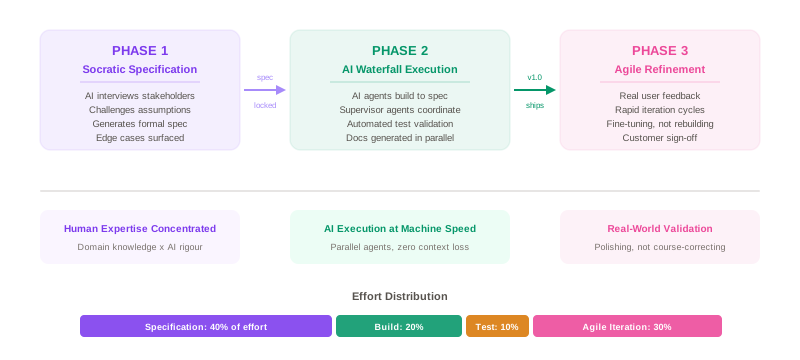
Figure: The Socratic lifecycle concentrates human expertise in the specification phase, hands execution to AI, and uses agile post-release for refinement rather than course correction.
Why the Economics Have Changed
For decades, software methodologies were designed around one central scarcity: developer time spent writing and reworking code.
AI changes that.
When implementation becomes cheaper, the bottleneck moves upstream. The real constraint becomes:
- specification clarity
- decision quality
- evaluation quality
Teams that improve those things are far more likely to realize the upside of AI. Teams that skip them simply generate bad software faster.
This is why the Socratic phase is not overhead. It is one of the highest-leverage activities in the delivery cycle.
Every ambiguity resolved before implementation reduces downstream rework. Every edge case surfaced early becomes an architectural decision made once instead of a production issue discovered later.
The Evidence Is Mounting
Specification-first, AI-assisted delivery is no longer just a thought experiment.
Across the market, teams are increasingly adopting:
- multi-step agent workflows
- spec-driven IDE flows
- coordinated agent execution
- stronger separation between problem framing and implementation
Different frameworks describe it in different ways, but the common lesson is consistent:
better specifications produce better outcomes.
What the Socratic method adds is the recognition that great specifications rarely emerge from stakeholders writing requirements in isolation. They emerge from rigorous questioning.
That is exactly where AI can be especially useful.
Waterfall Is Making a Comeback, But Not the Old One
The return of structured development does not mean going back to the waterfall of the 1990s.
It means recovering one of waterfall's strongest principles, getting the specification right before you build, while removing one of its biggest historical weaknesses: the cost and slowness of the upfront process.
AI makes that level of rigor more practical.
The result is a new hybrid:
- Socratic questioning to improve the specification
- structured AI-assisted execution to build against it
- agile refinement to improve the product after release
This is not a rejection of agile. It is a recognition that the old trade-offs have changed.
When implementation is nearly free, iterating on incomplete thinking is waste. The teams that reduce that waste will move faster with better outcomes.
The Road Ahead
The future of software development may begin earlier than many teams are used to.
Not with a sprint. Not with a prompt. Not even with a backlog.
It begins with better questions.
And in an AI-assisted environment, the teams that ask those questions rigorously will build better systems than the teams that skip straight to code.