



Microservices have become the default architecture choice for modern software systems. They promise scalability, team autonomy, and faster delivery. At large scale, these benefits are real. What is far less discussed is the hidden cost of microservices. Microservices do not eliminate complexity. They redistribute it into runtime behavior, infrastructure, and organizational processes. The result is a system that looks clean in diagrams but behaves unpredictably in production. Understanding these trade-offs is critical before adopting microservices, especially for teams that are not yet operating at scale.
What Microservices Actually Introduce
Microservices architecture decomposes an application into independently deployable services communicating over a network.
source
This introduces several fundamental characteristics:
- network-based communication instead of in-process calls
- distributed system behavior
- independent data ownership
- service-to-service dependencies
These properties fundamentally change how systems behave under load, failure, and change.
The Architecture Looks Simple. The System Is Not
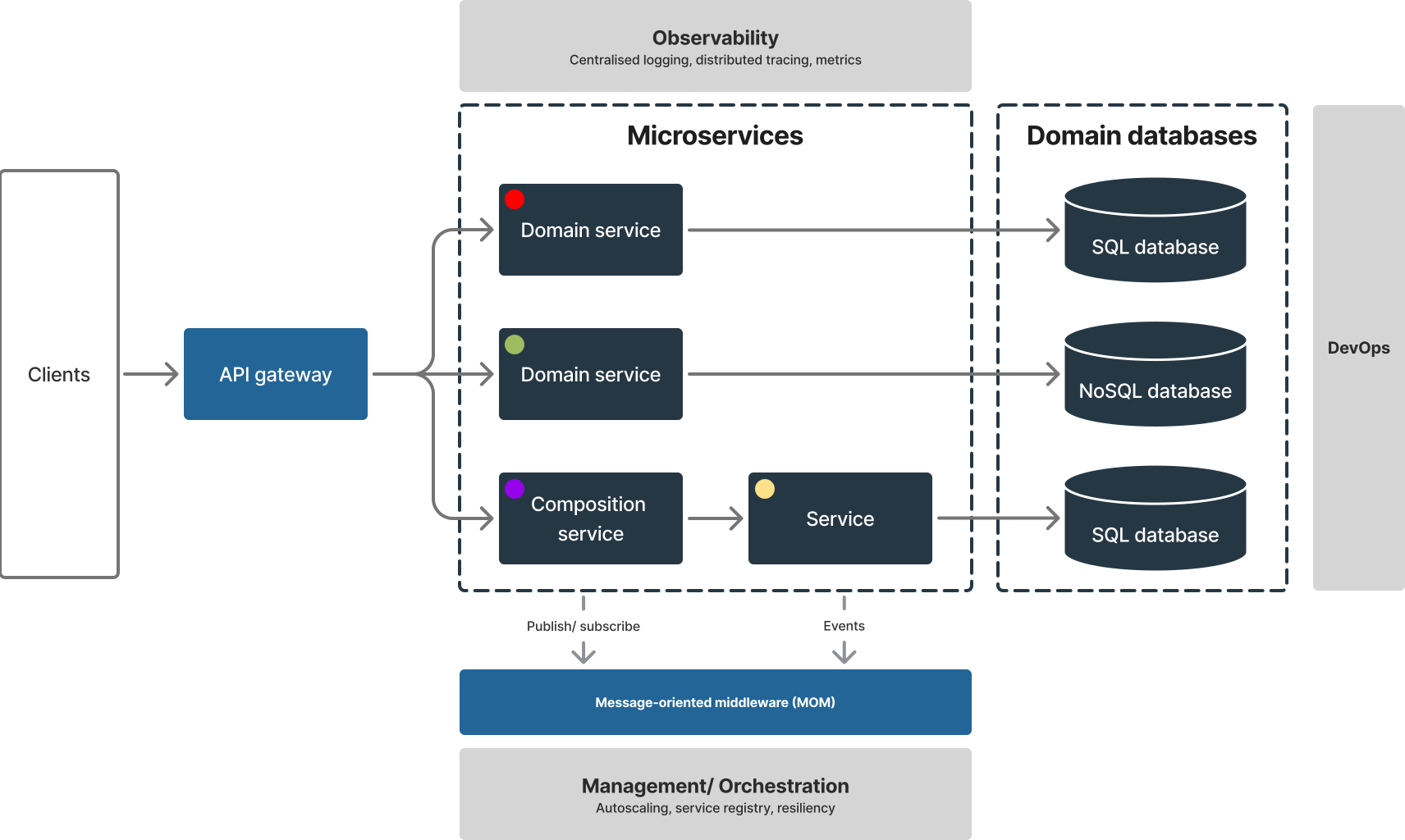
Figure: Typical microservices architecture with API gateway, service domains, message broker, and distributed data storage.
At a glance, this architecture appears modular and well-structured. In reality, every component introduces:
- additional network hops
- additional failure points
- additional operational overhead
The complexity is not visible in the diagram. It emerges during execution.
Hidden Cost #1: Latency Accumulation
Why network hops change everything
In a monolithic system, function calls are executed in memory and are effectively instantaneous. In microservices, every interaction becomes a network request.
A typical request path:
Client -> API Gateway -> Service A -> Service B -> Database
A simple latency model
Total latency can be modeled as:
L_total = L1 + L2 + L3 + ... + Ln
Where each L represents the latency of a service or network hop.
Example:
- API Gateway: 10ms
- Service A: 20ms
- Service B: 30ms
- Database: 40ms
Total baseline latency:
L_total = 100ms+
This excludes retries, queue delays, and network congestion. Latency grows with every dependency, and in real systems often increases non-linearly due to contention and retries.
Hidden Cost #2: Reliability Degradation
Why more services reduce reliability
Each service introduces a dependency required to fulfill a request. System reliability follows a multiplicative model:
R_total = R1 x R2 x R3 x ... x Rn
Where each R represents the reliability of an individual service.
Example
If each service has 99.9% availability:
R_total = 0.999^5 ~= 99.5%
This means:
- more services reduce total system reliability
- even highly reliable components degrade when combined
This is a property of distributed systems, not poor engineering.
Hidden Cost #3: Cascading Failures
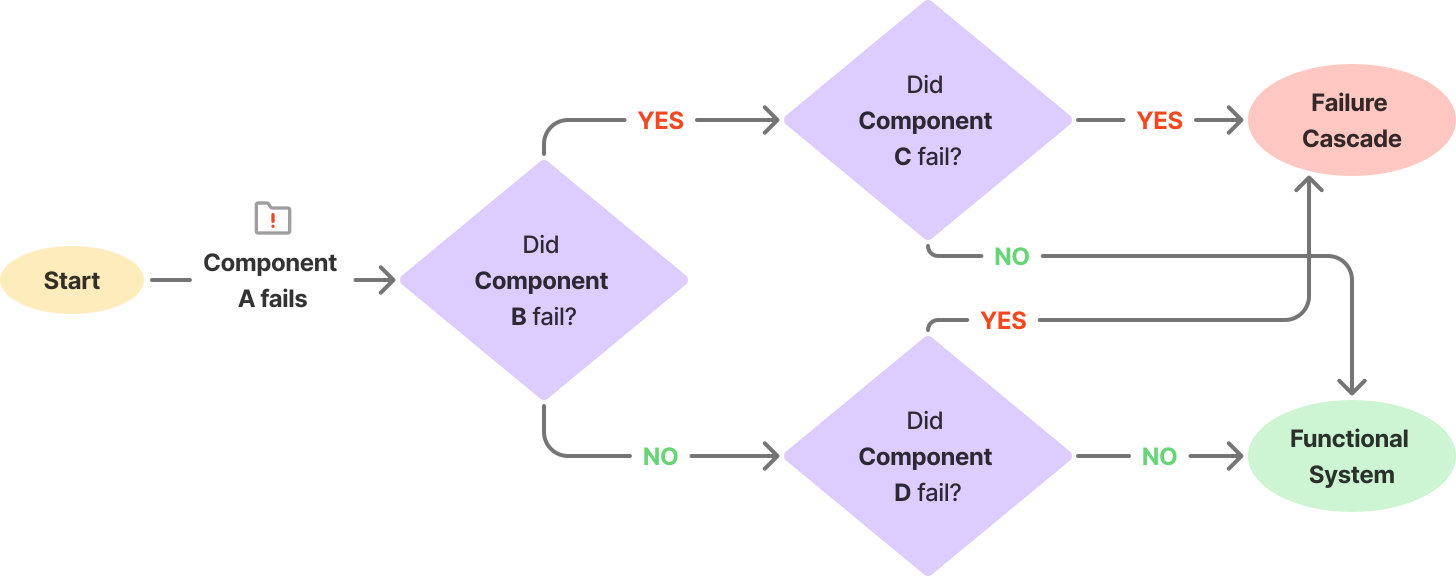
Figure: A failure in one service propagates across dependent services, causing system-wide degradation.
How cascades happen
A cascading failure occurs when:
- one service becomes slow or unavailable
- dependent services begin to wait or retry
- system load increases
- additional services degrade or fail
Real-world sequence
- Service B slows down
- Service A blocks waiting for response
- API Gateway accumulates requests
- Thread pools and connections saturate
- System-wide failure emerges
Why this is dangerous
Failures in distributed systems are not isolated. They propagate through dependencies.
Hidden Cost #4: Retry Amplification
When resilience makes things worse
Retries are often introduced to improve reliability. However, they can amplify load during failure conditions.
Effective load:
Load_effective = Base_load x (1 + Retries)
Example
- 100 requests
- 2 retries
Effective load becomes:
300 requests
Retries can overwhelm already degraded services, accelerating system collapse. This is commonly known as a retry storm.
Hidden Cost #5: Operational Overhead
Infrastructure complexity grows fast
Microservices require significantly more infrastructure than monoliths.
Typical components include:
- API gateway
- service discovery
- load balancing
- message brokers
- monitoring and alerting systems
- distributed tracing
- CI/CD pipelines per service
What this means in practice
Each component introduces:
- cost
- configuration complexity
- operational burden
At scale, infrastructure and observability become major investments.
Hidden Cost #6: Debugging Complexity
From simple to distributed debugging
Debugging a monolith:
- single runtime
- direct visibility
- linear execution
Debugging microservices:
- multiple services
- asynchronous flows
- partial failures
- distributed logs
What engineers must do
- correlate logs across services
- reconstruct request paths
- use tracing systems
This significantly increases:
- mean time to detection
- mean time to resolution
Hidden Cost #7: Data Consistency
The shift to eventual consistency
Microservices typically enforce database per service. This introduces eventual consistency. Instead of immediate consistency:
Write -> consistent state
Systems behave as:
State(t) != State(t + Dt)
Where Dt is synchronization delay.
Implications
- temporary inconsistencies
- reconciliation logic
- failure edge cases
Data becomes harder to reason about, especially during failures.
Hidden Cost #8: Organizational Complexity
Complexity moves beyond code
Microservices are often justified as enabling team autonomy. In reality, they introduce coordination requirements:
- API contracts
- versioning
- backward compatibility
- cross-team dependencies
The real shift
Complexity moves from:
code -> communication -> governance
This is often the most underestimated cost.
When Microservices Make Sense
Microservices are effective when:
- systems operate at large scale
- teams are large and independent
- domains are clearly defined
- infrastructure maturity is high
They are a scaling solution, not a default choice.
When Microservices Are a Mistake
Microservices are often harmful when:
- teams are small
- product requirements are evolving
- system scale is low
- infrastructure maturity is limited
In these cases, they introduce unnecessary complexity and cost.
A modular monolith is often a better alternative.
The Real Insight
Microservices do not reduce complexity.
They transform it into:
- latency
- probabilistic reliability
- failure propagation
- operational overhead
- organizational coordination
The diagram is simple.
The system is not.
Conclusion
Microservices can be powerful when used in the right context. At scale, they enable flexibility, resilience, and independent evolution. However, they come with significant hidden costs that are often underestimated. The most effective approach is not to adopt microservices by default, but to:
- start simple
- understand system behavior
- evolve architecture based on real needs
Because in software engineering: Complexity is easy to add, but extremely expensive to remove.