



Modern distributed systems are built on a fragile foundation. Every request depends on networks, services, and infrastructure that can fail independently. Failures are rarely binary. Systems degrade, slow down, and behave unpredictably. Resilience is not about preventing failure. It is about controlling how failure behaves.
Three fundamental mechanisms define this behavior:
- timeouts
- retries
- circuit breakers
Individually simple, together they determine whether a system recovers or collapses under pressure.
Why These Patterns Exist
In distributed systems:
- latency is unpredictable
- services can become unreachable
- resources are limited
These are not edge cases. They are normal operating conditions.
Source: https://sre.google/sre-book/
Retries, timeouts, and circuit breakers exist to handle these realities.
Request Lifecycle in Distributed Systems
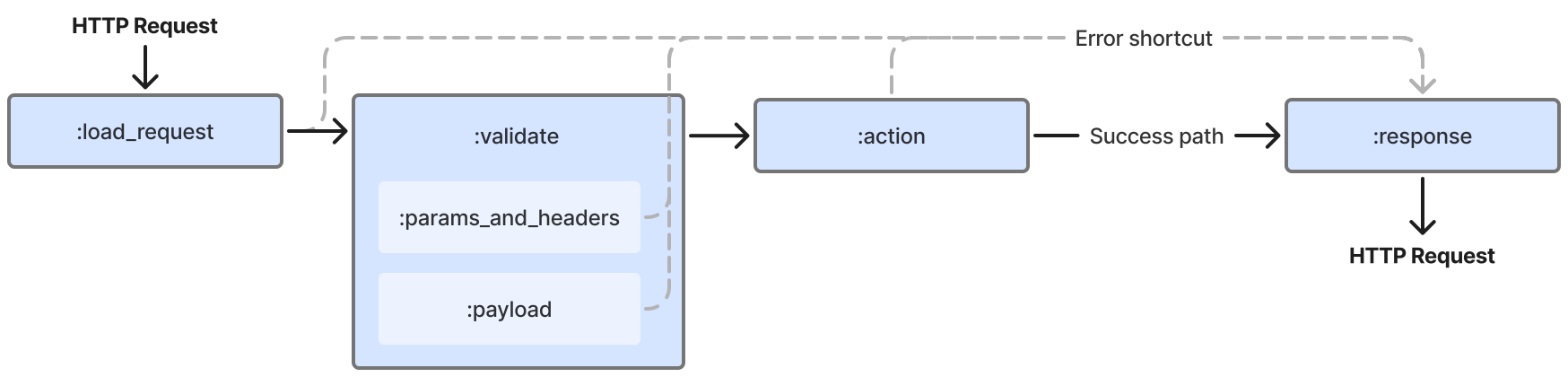
Figure: A request lifecycle across services, including timeouts, retries, and failure handling.
A single request typically flows through multiple layers:
Client -> Service A -> Service B -> Database
At each step:
- latency accumulates
- failures may occur
- retry logic may trigger
This is where resilience mechanisms operate.
Timeouts: Knowing When to Stop Waiting
What a Timeout Does
A timeout defines the maximum time a service will wait for a response.
If:
T_request > T_timeout -> request fails
Without timeouts:
- requests hang indefinitely
- threads remain blocked
- resources are exhausted
Why Timeouts Are Foundational
Timeouts are the first line of defense. They should be applied consistently across all service calls and enforced centrally where possible.
Timeout Tuning in Practice
Timeouts should not be arbitrary.
They should be based on:
- p95 or p99 latency
- expected load conditions
- acceptable error rates
Example:
If a service normally responds in 50ms but spikes to 200ms:
- timeout = 60ms -> too aggressive
- timeout = 5s -> too slow
A realistic timeout might be:
- 150-300ms depending on system behavior
Retries: Giving Failures a Second Chance
The Core Idea
Retries assume failures may be temporary.
If a request fails due to:
- network instability
- short-lived overload
Retrying increases success probability.
Exponential Backoff
Retries should not be immediate.
Delay = min(cap, base x 2^n)
Example:
- 1st retry -> 2s
- 2nd retry -> 4s
- 3rd retry -> 8s
This reduces pressure on downstream systems.
Source: https://newsletter.pragmaticengineer.com/p/resiliency-in-distributed-systems-74c
Retry Amplification
Retries increase load:
Load_effective = Base_load x (1 + Retries)
Example:
- 100 requests
- 2 retries
-> 300 requests
Retries improve success locally but degrade stability globally.
Retry Storms
When many clients retry simultaneously:
- load spikes
- services degrade
- failures increase
This creates a retry storm.
Mitigation:
- exponential backoff
- jitter (random delay)
- retry limits
Retry Amplification Across Service Chains
In a service chain:
Client -> Service A -> Service B -> Service C
Each layer may retry independently.
This creates exponential amplification:
- Service C receives the highest load
- failures propagate backwards
- system collapses under pressure
Best practice:
- retry at one layer only
- avoid retries deep in dependency chains
Source: https://newsletter.pragmaticengineer.com/p/resiliency-in-distributed-systems-74c
Circuit Breakers: Stopping the System From Hurting Itself
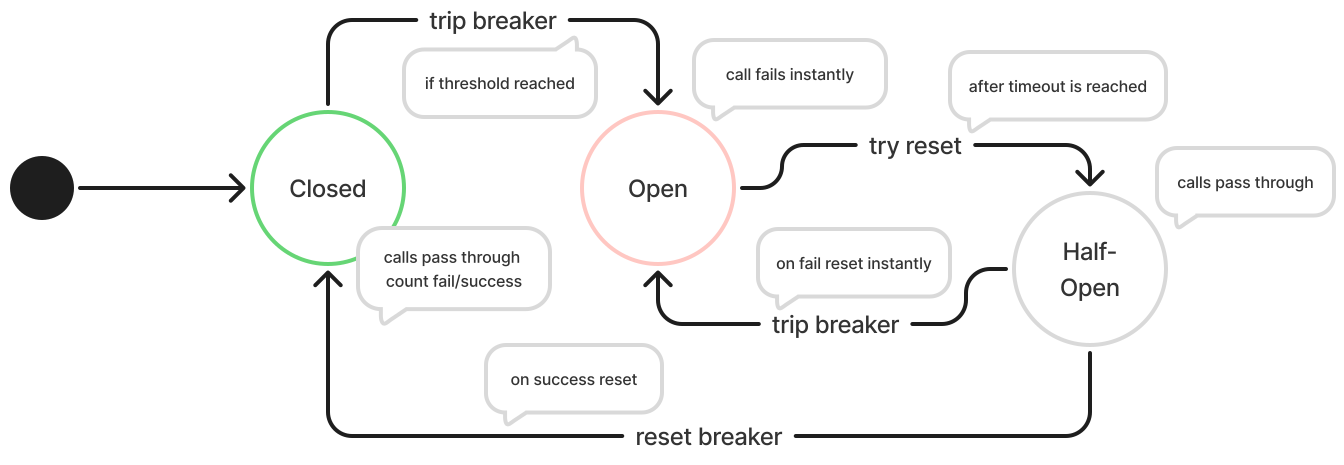
Figure: Circuit breaker state transitions: closed, open, and half-open.
The Core Idea
Retries assume the next attempt might succeed.
Circuit breakers assume the opposite.
If failures are persistent, the system stops making calls.
Circuit Breaker States
- Closed -> normal operation
- Open -> requests blocked
- Half-open -> test recovery
If:
Failure_rate > threshold -> circuit opens
Why Circuit Breakers Matter
Circuit breakers:
- reduce load on failing services
- prevent cascading failures
- enable faster recovery
They allow systems to fail fast instead of failing slowly.
Graceful Degradation
Instead of failing completely:
- return partial data
- disable non-critical features
- fallback to cached responses
This keeps systems usable under failure.
Idempotency: The Missing Piece
Retries only work safely if operations are idempotent.
What Is Idempotency?
An operation is idempotent if:
Repeated execution produces the same result.
Example:
- GET request -> safe
- payment request -> NOT safe unless controlled
Why It Matters
If retries are applied to non-idempotent operations:
- duplicate actions occur
- data becomes inconsistent
- financial or business errors happen
Example:
Retrying a payment request may charge a customer multiple times.
How Systems Handle This
Common approaches:
- idempotency keys
- request deduplication
- transactional guarantees
Without idempotency, retries introduce risk instead of resilience.
Real-World Failure Dynamics
Failures rarely happen instantly.
More often:
- service latency increases
- timeouts begin
- retries increase load
- service slows further
- circuit breaker eventually triggers
This creates a feedback loop.
The system does not fail suddenly. It collapses progressively.
How These Three Work Together
Typical sequence:
- request sent
- timeout triggered
- retry initiated
- load increases
- circuit breaker activates
Each layer influences the next.
These are not independent features. They form a system.
Common Implementation Mistakes
Missing Timeouts
Requests hang indefinitely.
Over-Aggressive Retries
Retry storms overload the system.
No Circuit Breakers
Failing services continue receiving traffic.
No Idempotency
Retries cause data corruption.
Poor Coordination
Mechanisms work against each other instead of together.
Best Practices
Apply Timeouts Everywhere
Never allow unbounded waiting.
Control Retries
- exponential backoff
- jitter
- retry limits
Use Circuit Breakers
Fail fast when systems degrade.
Ensure Idempotency
Make retries safe.
Monitor System Behavior
Track:
- latency percentiles
- retry rates
- failure rates
- circuit breaker states
Without observability, tuning is impossible.
The Real Insight
Retries handle transient failures. Circuit breakers handle persistent failures. Timeouts define system boundaries. Idempotency makes retries safe. Together, they define how a system behaves under stress.
Conclusion
Distributed systems fail in complex ways. Retries, timeouts, and circuit breakers are not optional.
They define:
- how failures propagate
- how systems recover
- how users experience outages
The difference between a resilient system and a fragile one is not whether failures occur. It is how the system behaves when they do.