



Abstract
Cloud architecture is often discussed in terms of services, platforms, and tooling. However, enterprise architecture decisions are rarely driven by technology alone. Instead, they are shaped by constraints: security requirements, regulatory environments, financial boundaries, legacy systems, organisational structure, and delivery velocity.
This article argues that cloud architecture should be understood as a structured response to constraints rather than as a technology selection exercise. Drawing conceptually on evolutionary architecture principles and enterprise cloud frameworks, we examine how constraint-driven thinking produces more resilient and strategically aligned systems.
1. Introduction
Modern enterprises frequently approach cloud transformation as a migration problem. The implicit assumption is that better technology leads to better systems. Yet large-scale failures in cloud adoption rarely stem from incorrect service selection. They emerge from unresolved constraints.
Security models, compliance obligations, cost ceilings, operational maturity, and human capability all impose structural boundaries on architecture decisions. Ignoring these constraints does not eliminate them. It merely postpones their consequences.
Architecture, therefore, is not a collection of components. It is a negotiated balance between competing forces.
2. Architecture as a Constraint Stack
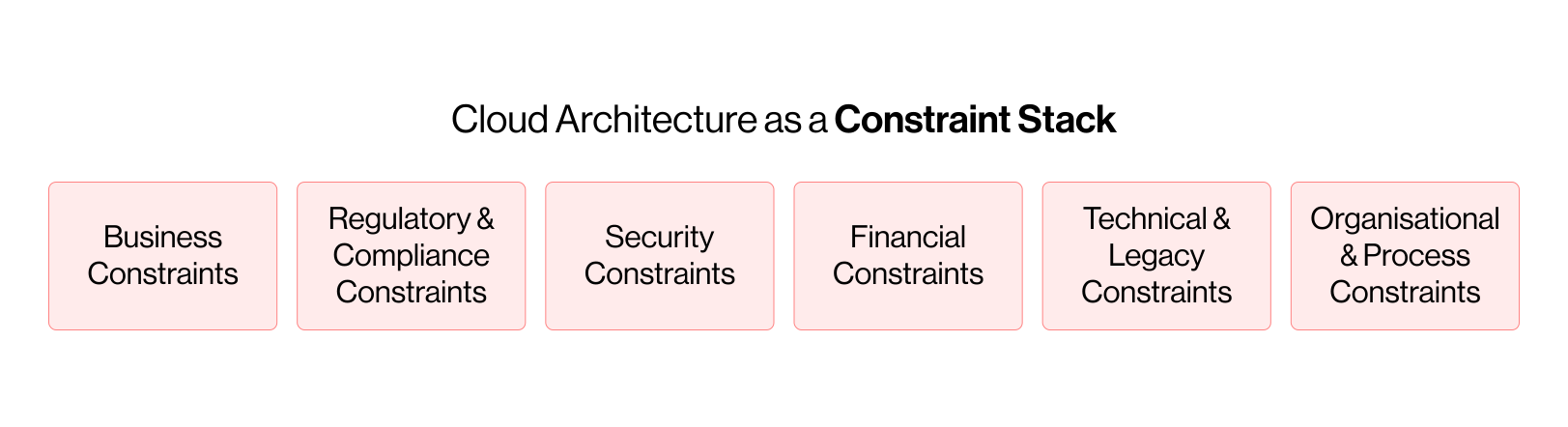
Cloud systems operate within a layered environment of limitations. These limitations can be conceptualised as a stack:
- Business constraints
- Regulatory and compliance constraints
- Security constraints
- Financial constraints
- Technical and legacy constraints
- Organisational and process constraints
Each layer narrows the available solution space. The role of the architect is not to eliminate constraints but to design coherently within them.
This aligns with evolutionary architecture thinking, where systems are shaped by "fitness functions" that continuously validate architectural integrity against defined characteristics [1]. These functions often encode constraints explicitly: latency thresholds, security boundaries, compliance rules, or cost limits.
Architecture quality, therefore, is measured not by elegance alone but by sustained alignment with these governing constraints.
3. Constraint Interaction in Real Decisions
In practice, architecture does not respond to constraints in isolation. Enterprise decisions typically sit at the intersection of multiple forces, each exerting pressure on the final design.
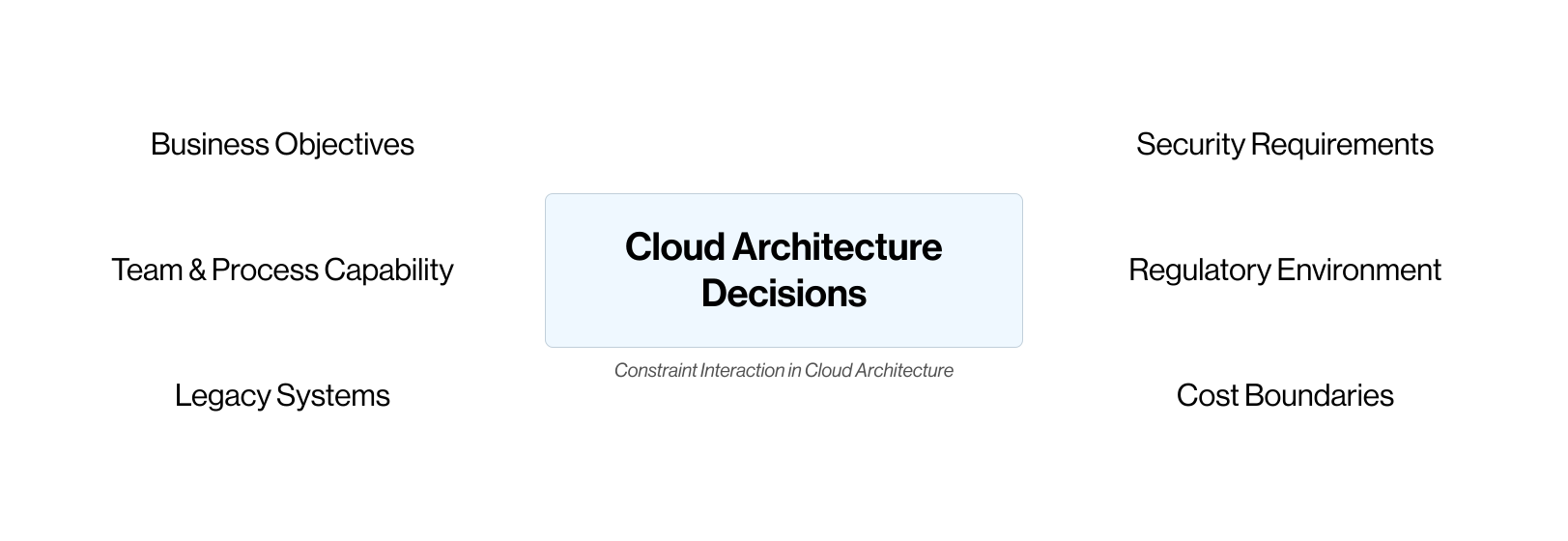
Understanding this interaction model helps teams avoid overly narrow solutions (for example, designing purely for security without cost visibility, or optimising cost while degrading operability). Strong architecture makes these trade-offs explicit and keeps them aligned to business intent.
4. Security and Compliance as Structural Forces
Security is frequently treated as an add-on to architecture. In enterprise contexts, it is foundational. Regulatory frameworks such as GDPR, ISO 27001, NIS2, or industry-specific mandates define non-negotiable system behaviours.
The AWS Well-Architected Framework emphasises security and operational excellence as core pillars, not optional enhancements [2]. Similarly, Microsoft's Cloud Adoption Framework positions governance and risk management as strategic enablers rather than blockers [3].
Compliance constraints influence:
- Data residency decisions
- Encryption strategies
- Identity and access management models
- Network segmentation patterns
- Audit logging architecture
Security architecture is therefore not a module. It is a structural determinant.
5. Cost and Financial Boundaries
Cloud introduces elasticity, but not infinite budget. Architectural decisions have direct financial implications: data transfer patterns, storage tiering, compute sizing, and availability design all affect cost profiles.
Trade-offs between redundancy and expense must be made explicitly. Over-architecture inflates operational burden. Under-architecture increases systemic risk.
Effective cloud architecture acknowledges cost as a first-class constraint and incorporates financial observability mechanisms to prevent architectural drift.
6. Legacy Systems and Organisational Reality
Few enterprises begin with a blank slate. Existing systems, contractual dependencies, and internal knowledge boundaries shape architectural possibilities.
Legacy integration often determines:
- API strategy
- Event streaming adoption
- Data replication models
- Migration phasing
Equally influential are people and processes. Research in Accelerate demonstrates that organisational capability strongly correlates with software delivery performance [4]. Architectural design that ignores team topology or operational maturity creates friction.
Cloud transformation, therefore, is as much organisational redesign as technical implementation.
7. Speed and Structured Proof of Concept
A common misconception is that rigorous architecture slows delivery. In practice, structured constraint analysis accelerates validation.
By identifying the governing constraints early, it becomes possible to design targeted proofs of concept that validate architectural direction within days rather than months. Focused experimentation within defined boundaries reduces rework and shortens decision cycles.
Speed does not emerge from bypassing constraints. It emerges from clarifying them.
8. Evolvability and Long-Term Alignment
Neal Ford et al. describe evolutionary architecture as systems designed to adapt incrementally while preserving architectural integrity [1]. This adaptability depends on clearly articulated constraints and measurable fitness functions.
Architecture that ignores constraint definition becomes brittle. Architecture that encodes constraints explicitly becomes evolvable.
Cloud platforms provide flexibility, but structure determines sustainability.
9. Conclusion
Cloud architecture is not a technology catalogue. It is a disciplined response to constraints.
Security, compliance, cost, legacy integration, organisational maturity, and business objectives collectively define the permissible solution space. Architects who acknowledge and structure these constraints produce systems that are resilient, adaptable, and strategically aligned.
Technology is the medium. Constraints are the architecture.
References
[1] Ford, N., Parsons, R., & Kua, P. Building Evolutionary Architectures. O'Reilly Media.
[2] AWS Well-Architected Framework.
[3] Microsoft Cloud Adoption Framework.
[4] Forsgren, N., Humble, J., & Kim, G. Accelerate. IT Revolution Press.