


The AWS Cloud is the biggest and most reliable cloud computing environment in the world, and has the goal to deliver the best service in any part of the globe. This environment is divided in regions, providing resources as close as possible to the end-user. Choosing the AWS region is one of the most important steps when creating an application, and some key factors should be considered when making this decision, like latency to the application's user, services availability and pricing. In this article, we are going to make your decision making a little easier when you need to pick one of the many regions available.
1. Latency
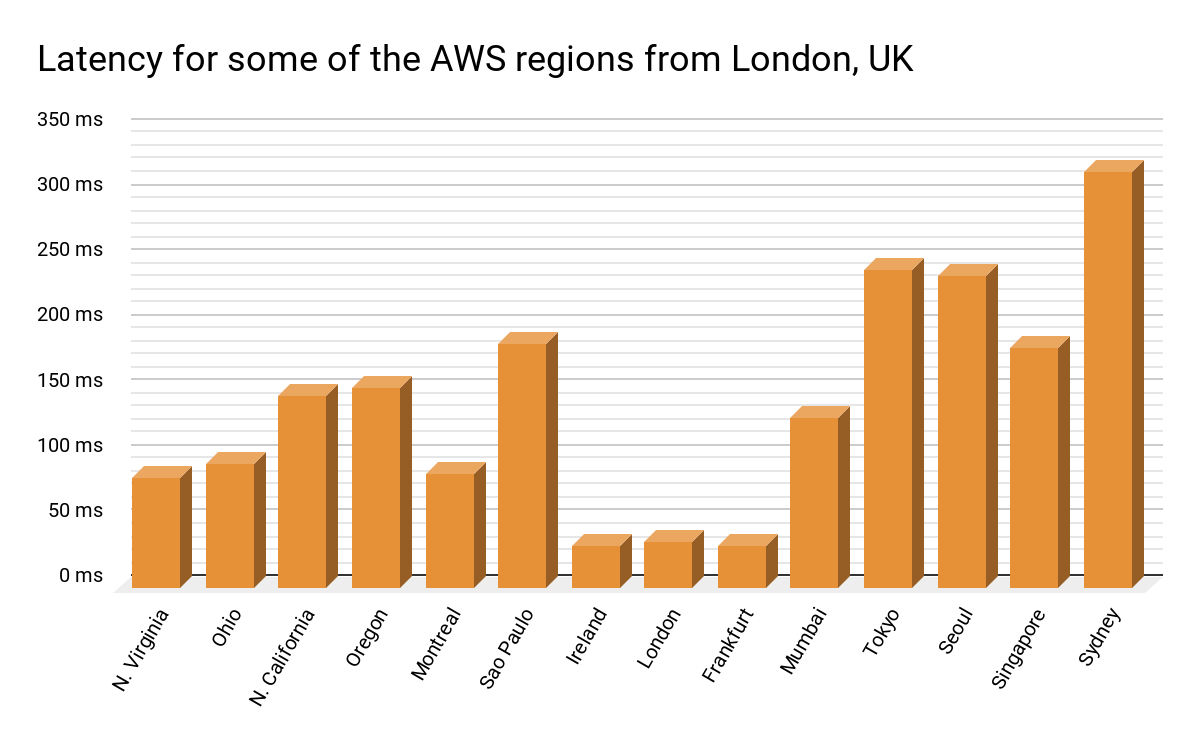
This is the most important factor if your application depends on low response time, and the most significant from the end-user's point of view. AWS has 22 regions launched right now, and five more set to be launched, making it even easier to have a region closer to where your users are. Some online tools can help you test the latency for each AWS region available, reducing the time you take to discover which region has the lowest latency for your application.
2. Reliability
AWS regions consist of a group of Availability Zones (AZ), in which the data within this given region is replicated across all AZs, increasing availability and fault tolerance. Each region has at least three AZs, excluding Beijing, which consists of two AZs. This factor is very important from a business perspective due to data redundancy, so you can assure your user's data will be secured even if one of the AZs faces some issue. Amazon provides a list of the Availability Zones for each of the AWS regions and detailed information and also an interactive map.
3. Services available
Some of the AWS services are not yet available in every region, which slightly reduces the options where your application can be launched according to the services it uses. Amazon provides a list of which services are available for each region and additional specific information for some regions.
4. Pricing
This might be the most important factor from the enterprise/project point of view. AWS pricing is not equal across all regions, making some services cheaper in one region compared to another. Taking Amazon EC2 service as a basis, here is a graph demonstrating the price per day of a m5d.2xlarge EC2 instance on-demand, which is a very good setup consisting of 32 GiB of memory and 300 GB of SSD storage.
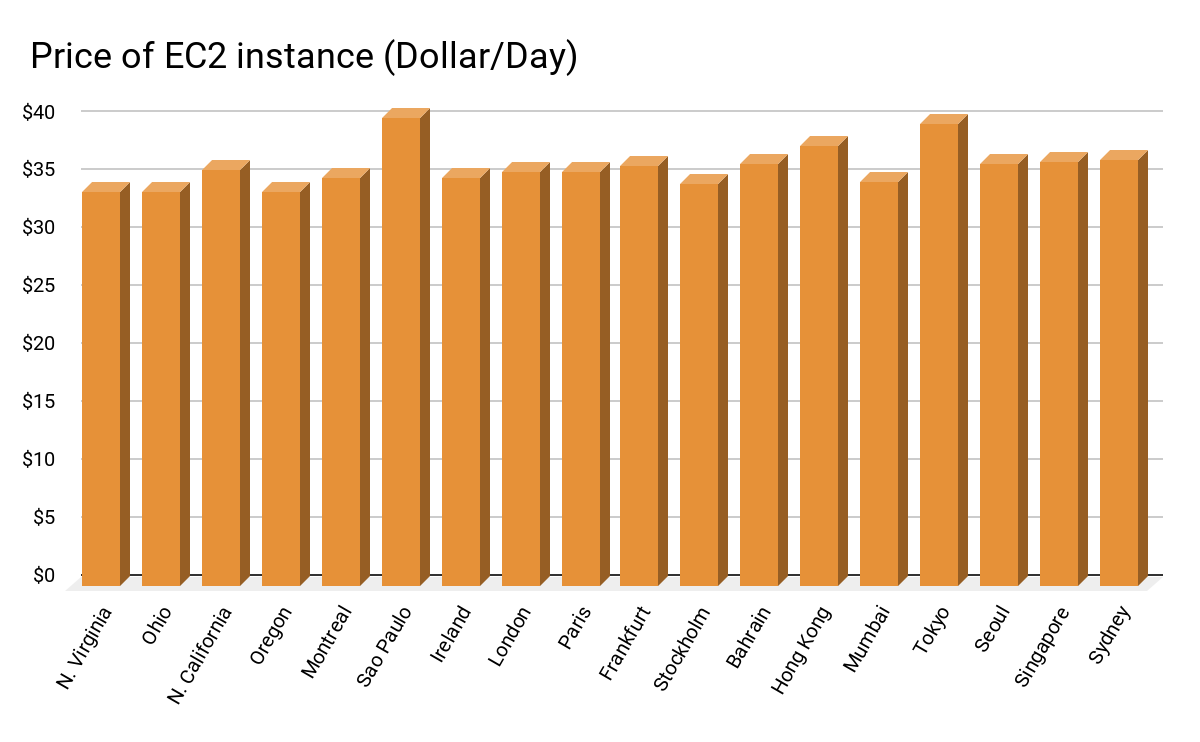
As you can see in the graph, Sao Paulo is the most expensive region, just a little bit over the 40 dollars landmark. On the other hand, North Virginia, Ohio and Oregon are the cheapest regions to place this type of EC2 instance, a little above 33 dollars. It is important to note that for this graph we used quite powerful EC2 instances to demonstrate the price difference. Smaller instances have a very little price difference, totalling less than one cent per hour across almost every region. If you want, check out the AWS pricing page.
Those are the main factors when choosing your AWS region, but availability, compliance and data residency can also interfere in your final decision. It is also important to note that AWS launched its first Local Zone in Los Angeles, linked to the Oregon region. It is designed to reduce the latency for the large population centres, and Amazon is expected to release more in the future. AWS also has two regions in the US for the American Government, US GovCloud East and West.
Choosing your AWS region might be quite a complicated task at first glance, but we hope our tips can help you get the most out of your choice to improve your business.